SOURCE:ShenzhenDailyPUBDATE:2026-06-19
What kind of industrial transformation will AI bring?
Will AI really replace human?
How should we coexist with AI?

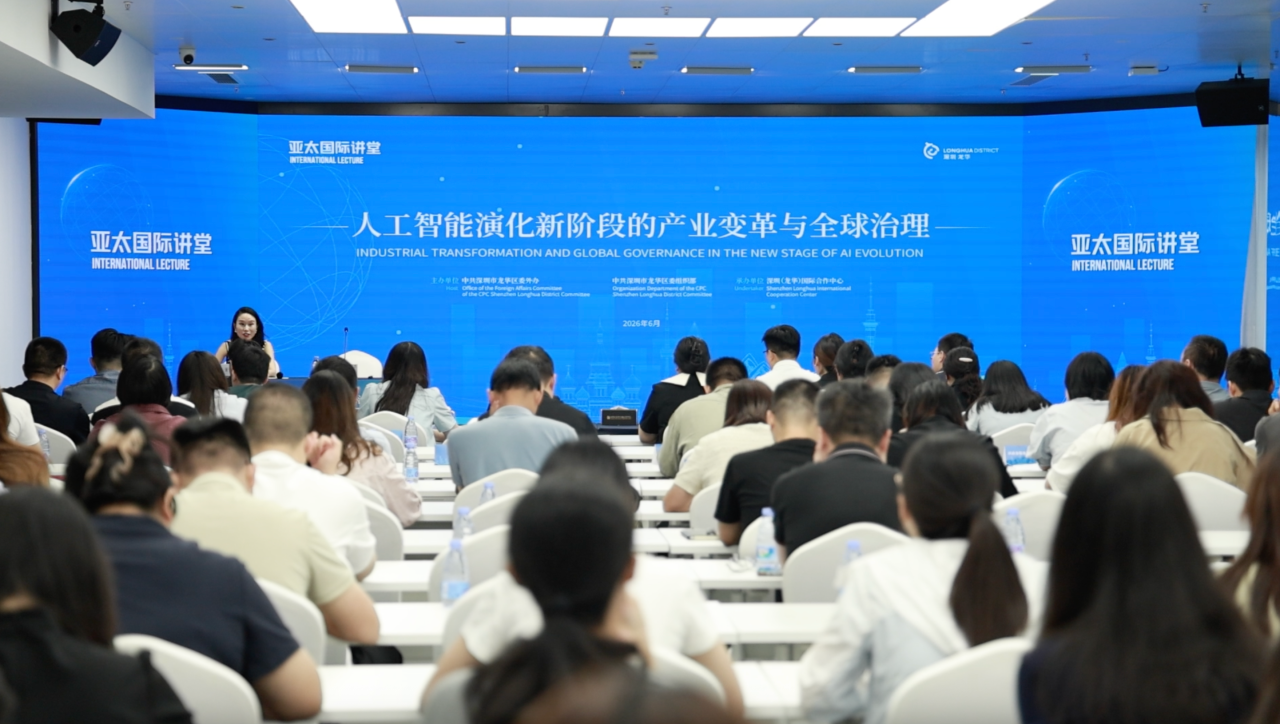
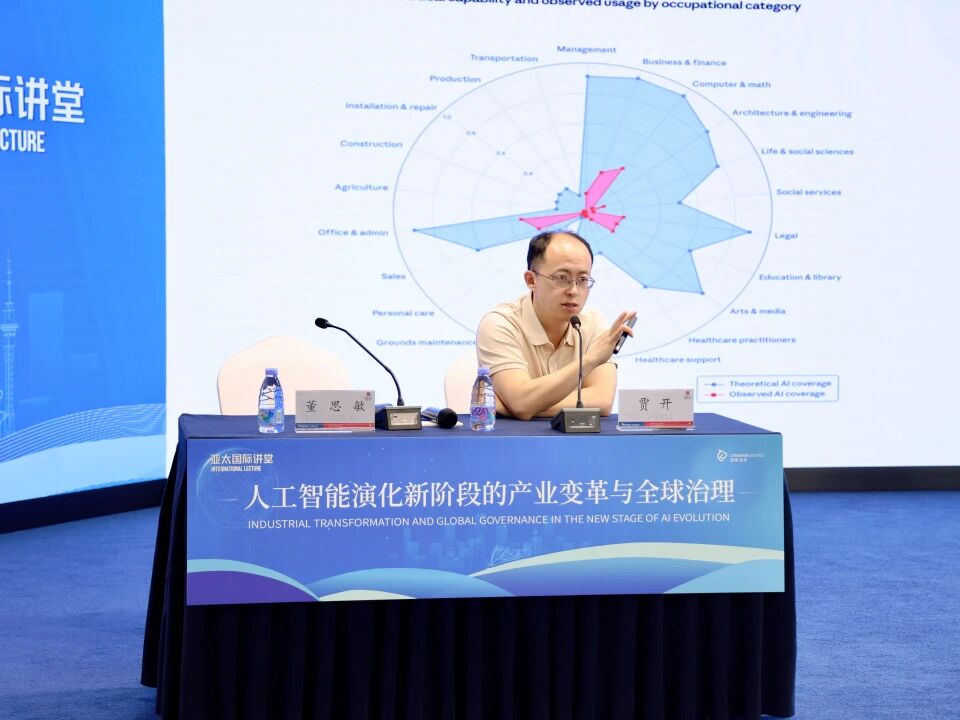
Jia Kai, professor and doctoral supervisor at the School of International and Public Affairs, Shanghai Jiao Tong University, gives a lecture on June 16 at the Shenzhen Longhua International Cooperation Center (LICC).
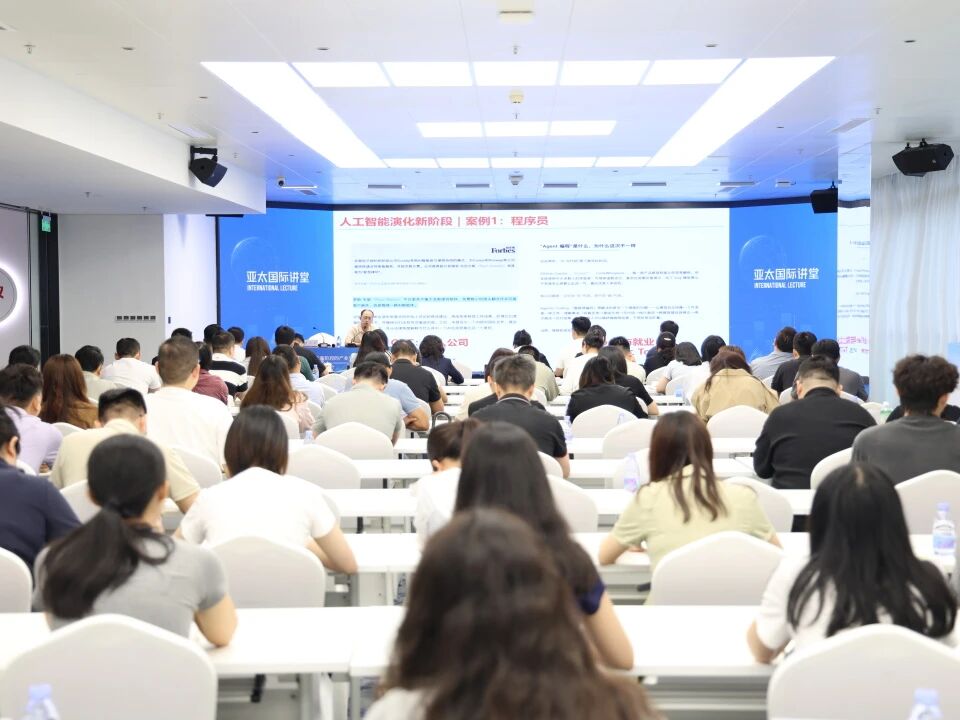
On June 16, Jia Kai, Vice Dean, Professor and Doctoral Supervisor, School of International and Public Affairs, Shanghai Jiao Tong University, delivered a special lecture titled "Industrial Transformation and Global Governance in the New Stage of AI Evolution" at the fourth session of the International Lecture Series hosted by Shenzhen Longhua International Cooperation Center. Through a two-hour in-depth discussion, he offered his perspectives on these pressing questions. More than 100 participants from relevant government departments and representatives from enterprises across the district attended the event.
Professor Jia pointed out that more than 70% of programmers are unlikely to lose their jobs because of AI. However, their ways of working and their knowledge structures will be fundamentally reshaped.
He cited the example of Zhao Weicheng, a 63-year-old engineer specializing in prefabricated construction, who "taught" AI the industry knowledge and rules he had accumulated over four decades. A project that previously required a team of three PhD holders and four master's degree holders working for three months was completed by him alone in just five days. AI is making the rise of "super individuals" possible, but only for those who actively learn to collaborate with AI rather than passively waiting to be replaced by it.
Another example was Dai Jiawei, a family caregiver for a chronic disease patient, who developed an intelligent health assistant in just two days. With the latest generation of AI models, a similar task now takes him only two hours to finish it. Reflecting on this case, Professor Jia remarked, "The true value of technology lies in its willingness to serve even the smallest needs."
Drawing lessons from history, Professor Jia noted that after electric motors replaced steam engines, it took factories nearly 40 years to develop distributed production systems before productivity gains were fully realized.
Today, AI faces a similar "productivity paradox". AI will not automatically improve efficiency. To unlock its full potential, organizations must simultaneously advance institutional, managerial, and governance reforms.
Using the Hollywood writers' strike as an example, he explained that the core issue was not whether AI should be prohibited, but rather questions such as who owns the copyright to AI-generated content and whether writers have the right to be informed when AI is involved in content creation. These debates are helping to define the rules that will shape the future of industries worldwide.
The rise of DeepSeek demonstrates that relying solely on proprietary models and ever-increasing computing power is not the only path forward. The collective intelligence fostered by open-source ecosystems may prove to be more sustainable and innovative in the long run.
At the same time, investment in AI infrastructure has reached an estimated US$7 trillion, while NVIDIA has surpassed a market capitalization of US$5 trillion, reflecting a highly concentrated market structure.
Against this backdrop, different governance approaches are emerging. While the United States advocates a lighter regulatory framework, China has proposed that AI should be developed as an international public good. Ultimately, those who shape the governing principles of AI may also gain the greatest influence over the next wave of industrial transformation.
The greatest takeaway from this lecture
was not the answers it offered,
but the questions it inspired.
If AI can write better code,
process information faster,
and perform more tasks than ever before,
what will make human indispensable?
Perhaps the answer lies in our creativity,
our judgment, and our capacity
to collaborate with technology.
The future belongs not to those who resist AI,
but to those who learn how to dance with it.


 Telephone 0755-27617814Email [email protected]
Address 4 / F, Tower B, OCT Central One, Mintang Road, Longhua District, Shenzhen
Opening Hours 9:00 a.m. - 12:00 p.m., 2:00 p.m. - 6:00 p.m. Monday to Friday (excluding statutory holidays)
Website ID: 4403920006
Sponsored by: General Office of Longhua District People's Governmen

Without written authorization from Longhua District People’s Government,the content of the site shall not be republished or used in any form


